Friday, November 20, 2020
HHS adopts final HealthIT strategic plan
PARCA eNews – Oct. 30, 2020 – The U.S. Department of Health and Human Services (HHS) published its final 2020-2025 Federal Health IT Strategic Plan (the Plan) Oct. 30, 2020, which includes provisions for supporting patient access to their own health information.
Tuesday, November 17, 2020
HHS extends compliance dates for information blocking and Health IT certification requirements
Oct. 29, 2020 – The US Health and Human Services has extended the deadline for compliance with a number of requirements of the 21st Century Cures Act in response to challenges to organizations complying resulting from the pandemic.
Last March ONC’s Cures Act Final Rule established exceptions to the 21st Century Cures Act’s information blocking provision and adopted new health information technology (health IT) certification requirements to enhance patients’ smartphone access to their health information at no cost through the use of application programming interfaces (APIs).
The interim final rule issued Oct. 29, 2020 extends the program compliance dates beyond those identified in the April 21, 2020 as follows:
Monday, September 28, 2020
Universal patient identifiers are about patient safety
![]() |
| Photo credit: University of Texas, Austin |
In 2018, Miri was congressionally appointed by Senator Chuck Schumer to the Health and Human Services (HHS), federal Health IT Advisory Committee, established under the 21st Century Cures Act. He was federally appointed by HHS Secretary Sylvia Burwell to serve on the HHS Health IT Policy Committee established under the American Recovery and Reinvestment Act of 2009. Miri is the prior chair of the Healthcare Information and Management Systems Society (HIMSS) National Public Policy Committee and serves as an expert adviser to the United States Senate Committee on Health, Education, Labor and Pensions and to other congressional panels engaged in numerous Health IT policy topics. PARCA eNews spoke to Mr. Miri about the challenges of adopting a national universal patient identifier.
Patient ID Now Coalition delivers 3 recommendations to ONC workshop
![]() |
| Courtesy of Patient ID Coalition |
HIMSS Vice President for Government Relations Tom Leary and Meryl Bloomrosen, Senior Director, Federal Affairs for Premier Healthcare Alliance, represented the Patient ID Now Coalition at the session during the Alliances & Coalitions segment.
As part of their observations, the Patient ID Now Coalition made the recommendations following a necessary first step of Congress removing Section 510 of Labor HHS Appropriations, which bans HHS from promulgating a unique patient identifier.
First ransomware attack tied to patient death, negligent homicide charge possible
PARCA eNews – Sept. 18, 2020 – In what is believed to be a first, a ransomware attack has led to a patient death according to reports in HIPAA Journal and Fortune Magazine.
The Sept. 10, 2020 attack crippled the Heinrich Heine University Clinic in Dusseldorf, Germany. The 78-year-old woman patient required immediate emergency treatment for an aneurysm and had to be diverted to another emergency facility 21 miles away. The one-hour delay was noted as contributing the the patient’s death.
CMS announces innovative payment model for radiation oncology
The new Radiation Oncology model allows for value-based focus by creating a simpler, more predictable payments that incentivize cost-efficient and clinically effective treatments to improve quality and outcomes. Current payment is based on the number of treatments and where patients receive it such as in a hospital outpatient department or a freestanding radiation therapy center, which can lead to more time traveling for treatment with little clinical value, according to CMS Administrator Seema Verma.
Trend to home PACS for radiology likely to continue
PARCA eNews – Aug. 9, 2020 – Radiologists will be shifting more of their workdays to reading from home or other remote locations after the COVID-19 crisis has passed, according to a new survey.
In an effort to examine effects of COVID-19 on radiology practices, a group of radiologists conducted a survey of nearly 290 practices representing a geographically diverse cross section of institutions. The results were published in mid-May in the Journal of the American College of Radiology.
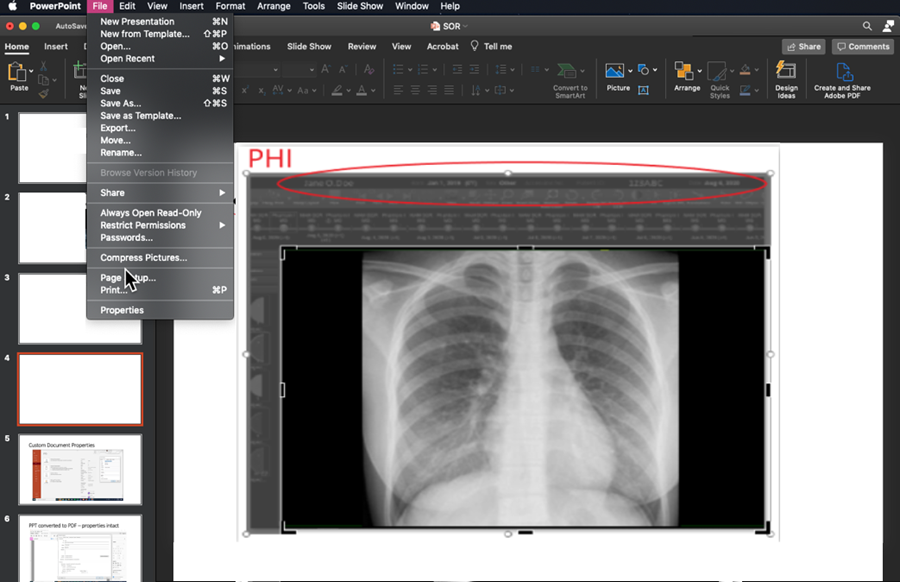
PHI vulnerable to extraction from online presentations
![]() |
| Patient data can be extracted from Images imported from a PACS into an online PowerPoint |
PARCA eNews – Aug. 28, 2020 – The Radiological Society of North America (RSNA), the American College of Radiology (ACR), and the Society for Imaging Informatics in Medicine (SIIM), are warning that online medical presentations are at risk of accidental exposure of protected health information (PHI).
In a paper on the ACR website, the group shows how advances in web-crawling and content processing technology is increasingly able to allow large-scale information extraction from previously stored files. The technology allows extraction of medical images contained in PowerPoint presentations and PDF files and recognized alphanumeric character information embedded in those images, including patient information.
KA imaging technology given FDA nod; begins COVID-19 early detection trial
PARCA eNews – September 22, 2020 – The U.S. Food & Drug Administration (FDA) awarded 510(k) clearance to Ka Imaging, Inc., Monday for Reveal, its portable, dual-energy X-ray detector that, company officials, said can be used to slow the spread of COVID-19.
The company’s Reveal™ machine enables bone and soft-tissue differentiation without motion artifacts in a single X-ray exposure. In other words, with one shot, the detector simultaneously delivers DR, bone, and tissue images.
Pandemic pushes telehealth to top IT concerns
![]() |
| Credit Office of Connected Care - Veterans Affairs |
The survey found that 8 of 19 executives named solving telehealth problems as their number one problem during the early stages of the pandemic. Since then, nearly all of the executives say they have workable solutions in place, or are implementing one.
Subscribe to:
Posts (Atom)